This blog attempts to collate various materials in connection with the year 1735.

20071008

Francis Barber


Francis Barber (ca 1735 – 1801) was the Jamaican manservant of Samuel Johnson from 1752 until Johnson's death in 1784. Johnson made him his residual heir, with £70 a year to be given him by Trustees, expressing the wish that he move from London toLichfield, Staffordshire, Johnson's native city. After Johnson's death, Barber did this, opening a draper's shop and marrying a local girl. Barber was also left Johnson's books, papers and gold watch. In later years he had acted as Johnson's assistant in revising hisfamous dictionary and other works.
Barber wasborna slave on a sugarplantation in Jamaica. Around the age of 15 he was brought toEngland by his owner, Colonel Richard Bathhurst, whose son, also called Richard, was a close friend of Johnson. He was sent to school inYorkshire. Johnson's wife Elizabeth Porter died in 1752, plunging Johnson into a depression that Barber later vividly described to Boswell. The Bathursts sent Barber to Johnson as a valet, arriving two weeks after her death. Although thelegal validity of salvery in England was ambiguous at this time (a later legal decision clarified that it did not exist in England), when the elder Bathurst died two years later he gave Barber his freedom in his will, with a small legacy of £12. Johnson himself was an outspoken opponent of slavery, not just in England butin the American Colonies too.
Barber then went to work for an apothecary but kept in touch with Johnson. He later signed up as a sailor, until retrieved, perhaps against his wishes, by Johnson, returning to be his servant. Barber's brief maritime career is known from Boswell's Life of Johnson. “
Later Johnson put Barber, by then in his early thirties, in a school, presumably so that he could act as Johnson's assistant.
Barber is often mentioned in Boswell and other contemporary sources, and there are at least two versions of a portrait, one now in Dr Johnson's House [see pic] which may be of him. Most recent art historians thought it was probably painted by James Northcote (painter of the shark incident I mentioned recently) or perhaps by Northcote's master SirJoshau Reynolds, one of Barber's Trustees under the will (and afriedn of Johnson). An alternative view is that it is by Reynolds himself, but of his own black servant, not Barber.
When making his will, Johnson asked Sir John Hawkins, later his first biographer, what provision he should make for Barber. Sir John said that a nobleman would give £50 a year. Then I shall be "noblissimus" replied Johnson, and give him £70. Hawkins disapproved, and after Johnson's death criticised his "ostentatious bounty and favour to negroes." The bequest was indeed widely covered in the press.
Barber's life in Staffordshire was unsettled and he was apparently given to drinking. He died inStafford; his descendants still farm near Lichfield.

20071005

Wesley's Journal 05


Friday 24 [October], Having a rolling sea, most of the passengers found the effects of it. Mr. Delamotte was exceeding sick for several days: Mr. Ingham for about half an hour. My brother's head ached much. Hitherto it has pleased God, the sea has not disordered me at all; nor have I been hindered one quarter of an hour from reading, writing, composing, or doing any business I could have done on shore. During our stay in the Downs, some or other of us went as often as we had opportunity on board the ship that sailed in company with us, where also many were glad to join in prayer and hearing the word.

Shark man

Sir Brook Watson, Bart (1735-1807) was a British merchant, soldier and one-time Lord Mayor of London. He was perhaps most famous for being the subject of Watson and the shark, a painting by John Singleton Copley which depicted the shark attack on Watson as a boy. As a result of the attack Watson lost his right leg below the knee. More here.

20071001

Wesley's Journal 04

Tuesday 21 [October], We sailed from Gravesend. When we were past about half the Goodwin Sands, the wind suddenly failed. Had the calm continued till ebb, the ship had probably been lost; but the gale sprung up in an hour, and carried us into the Downs.
We now began to be a little regular. Our common way of living was this: From four in the morning till five, each of us used private prayer; from five to seven we read the Bible together, carefully comparing it (that we might not lean to our own understanding) with the writings of the earliest ages. At seven we breakfasted. At eight were the public prayers. From nine to twelve I usually learned German, and Mr. Delamotte, Greek. My brother [Charles. see pic] wrote sermons, and Mr. Ingham instructed the children. At twelve we met to give an account to one another what we had done since our last meeting, and what we designed to do before our next. About one we dined.
The time from dinner to four, we spent in reading to those whom each of us had taken in charge, or in speaking to them seriously, as need required, At four were the evening prayers; when either the second lesson was explained (as it always was in the morning) or the children were catechised and instructed before the congregation. From five to six we again used private prayer. From six to seven I read in our cabin to two or three of the passengers (of whom there were about eighty English on board) and each of my brethren to a few more in theirs. At seven I joined with the Germans in their public service; while Mr. Ingham was reading between the decks to as many as desired to hear. At eight we met again to exhort and instruct one another. Between nine and ten we went to bed, where neither the roaring of the sea, nor the motion of the ship, could take away the refreshing sleep which God gave us.

20070928

Wesley's Journal 03


Monday 20 [October], Believing the denying ourselves even in the smallest instances, might, by the blessing of God be helpful to us, we wholly left off the use of flesh and wine, and confined ourselves to vegetable food, chiefly rice and bisket. In the afternoon David Nitchman, bishop of the Moravians, and two others began to learn English. O may we be, not only of one tongue, but of one mind and of one heart!

Wesley's Journal 02

Friday 17 [October], I began to learn German, in order to converse with the Moravians, six and twenty of whom we had on board. On Sunday, the weather being fair and calm, we had the morning-service on quarter deck. I now first preached extempore, and then administered the Lord's Supper to six or seven communicants, A little flock. May God increase it !
This is a replica of a desk chair from around 1735 found here.

20070908

Latitude


Theoretically a degree of latitude is a constant, the same at the equator as at the pole. However, Isaac Newton believed that the earth was slightly flattened at the poles, an oblate spheroid, and that the length of a degree at the poles was longer than it was at the equator. On the other hand French mathematicians argued either for a perfect sphere or for a prolate spheroid, one which bulged at the poles.
The French Royal Academy of Sciences determined to settle the matter by sending expeditions to the Equator and to the Arctic Circle. If the length of a degree were longer at the Arctic Circle than at the Equator the spheroid would be oblate, flat at the poles; if it were shorter, prolate, and if the degrees were equal, then the earth would be spherical.
In 1735 the French Royal Academy of Sciences sent out two geodetic expeditions to determine the length of a degree at the pole and at the equator. The expedition to the Arctic Circle was under the leadership of Pierre-Louis Moreau de Maupertuis went to the Arctic Circle. The one to the Equator had Charles Marie de La Condamine (see pic) as its chronicler. Near Quito, in what is now Ecuador, a base line was established by triangulation, and the length of the degree of latitude was measured.

Ruth Dunster

Ruth Dunster, daughter of Henry and Martha Dunster, died in 1735 at 1 year, 9 months. In her grave, her sister Elizabeth, age 4 months, lies next to her. A grave nearby reveals another tragically young death and refers to a larger historical context: "Beneath this tomb rests the remains of Mr. Jon Hughes, only son of Mr. John Hughes of Norwich in Connecticut. He died in his Country's Cause July 25th AD 1775 in Ye 21st Year of his Age." Henry Dunster was the son of Henry Dunster, Harvard's founding president who is buried nearby.

Ch'en Shu


This work entitled New Year's Day was produced in 1735 using ink and colours on paper. It is by Ch'en Shu (1660-1736) and is Qing Dynasty. Ch'en Shu was a native of Hsiu-shui in Chekiang Province, China. She was noted for her paintings of flowers, birds, insects and grasses and landscapes. Her brush was strong and vigorous and possessed the spirit of the antique. This scroll was painted when she was 75.

Porcelain Factory


In the year 1735, Baron Rudolf Johann of Wrisberg (picture), who was engaged at the time as the President of the Upper Court of Appeal in Celle, commisioned his administrator, Rasch, with looking into the possibility of setting up a "pipe factory". While nothing ever came of this pipe production, because of the lack of the necessary kaolin, nontheless clay deposits were discovered in the process, and tests revealed that this clay was suitable for fayence production. Since the surrounding forests belonging to the estate provided sufficient quantities of fuel for running a kiln, Rudolf Johann of Wrisberg decided to set up a large fayence factory.

The following year the buildings of the "porcellain factory" were erected in the kitchen garden northwest of the castle by the Untere Dorfstraße in Wrisbergholzen in Germany.

20070907

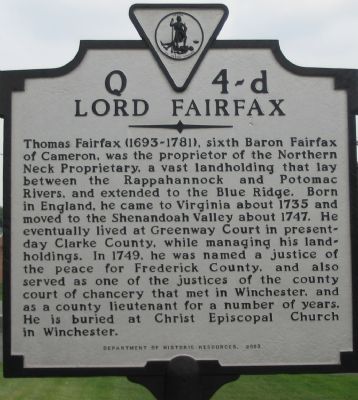
Winchester, VA


This marker is found in Winchester, Virginia, USA, and was erected in 2003. It refers to Lord Fairfax arriving in America 'about 1735'. For more see here.