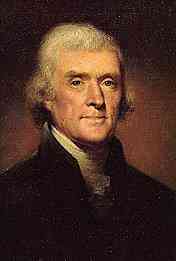
Elizabeth "Betty" Hemings was born around 1735, somewhere west of Monticello, Albemarle County, Virginia, now USA. She was an American slave owned by Thomas Jefferson (see pic), said to have been the concubine of Jefferson's father-in-law John Wayles, from whom Jefferson inherited her and her family. Over 75 of her children, grandchildren and great-grandchildren were enslaved at Jefferson's estate in Monticello.
According to the oral history of her descendants, Betty was the daughter of a slave-ship captain named Hemings and a woman born in Africa. Her place of birth is uncertain, but by the 1740s she was the property of Frances Eppes IV, of the Bermuda Hundred plantation, whose daughter Martha Eppes was to become John Wayles first wife.
Betty's grandson, Madison Hemings, related the story that Betty was already the property of "John Wales" at her birth, and her father Captain Hemings attempted to purchase her from Wayles, but Wayles refused because he was curious about how a mulatto child would develop. Captain Hemings then plotted to kidnap his daughter, which Wayles got word of, and took measures against. This account appears to contradict the documentary evidence pertaining to Betty's birth and early life, though it is possible that Wayles could have sold Betty to Frances Eppes, and later regained ownership of her via the dowry of Eppes's daughter, or that Madison's chronology is incorrect and the incident, if it occurred, happened later.
After the marriage of John Wayles and Martha Eppes 1746, Elizabeth became the property of Wayles, and was moved to one of his plantations, where she became a household servant. In the 1750s she gave birth to the first four of her 12 children, whose paternity is unknown.
John Wayles had three wives, all of whom pre-deceased him. In 1761, after the death of his third wife, Wayles took Betty Hemings as his concubine. According to her descendants, she had six children with Wayles including Sally Hemings (thought to have had a child with Jefferson). Wayles died 1773, and all 11 members of the Hemings family became the property of Thomas Jefferson.
Jefferson gave the Hemingses privileged positions as artisans and household servants. No member of the Hemings family ever worked the field. While resident at Monticello, Betty gave birth to another son, John, whose father was an Irish workman.
Betty had her own home at Monticello, where she spent roughly the last decade of her life, 1795-1807. Hemings sold cabbages, strawberries and chickens to Jefferson while she lived there. Her former cabin is now an archaeological site.
According to the oral history of her descendants, Betty was the daughter of a slave-ship captain named Hemings and a woman born in Africa. Her place of birth is uncertain, but by the 1740s she was the property of Frances Eppes IV, of the Bermuda Hundred plantation, whose daughter Martha Eppes was to become John Wayles first wife.
Betty's grandson, Madison Hemings, related the story that Betty was already the property of "John Wales" at her birth, and her father Captain Hemings attempted to purchase her from Wayles, but Wayles refused because he was curious about how a mulatto child would develop. Captain Hemings then plotted to kidnap his daughter, which Wayles got word of, and took measures against. This account appears to contradict the documentary evidence pertaining to Betty's birth and early life, though it is possible that Wayles could have sold Betty to Frances Eppes, and later regained ownership of her via the dowry of Eppes's daughter, or that Madison's chronology is incorrect and the incident, if it occurred, happened later.
After the marriage of John Wayles and Martha Eppes 1746, Elizabeth became the property of Wayles, and was moved to one of his plantations, where she became a household servant. In the 1750s she gave birth to the first four of her 12 children, whose paternity is unknown.
John Wayles had three wives, all of whom pre-deceased him. In 1761, after the death of his third wife, Wayles took Betty Hemings as his concubine. According to her descendants, she had six children with Wayles including Sally Hemings (thought to have had a child with Jefferson). Wayles died 1773, and all 11 members of the Hemings family became the property of Thomas Jefferson.
Jefferson gave the Hemingses privileged positions as artisans and household servants. No member of the Hemings family ever worked the field. While resident at Monticello, Betty gave birth to another son, John, whose father was an Irish workman.
Betty had her own home at Monticello, where she spent roughly the last decade of her life, 1795-1807. Hemings sold cabbages, strawberries and chickens to Jefferson while she lived there. Her former cabin is now an archaeological site.
Relationship with John Wayles
Historians have tended to accept the account that Betty Hemings and John Wayles had children together, although, as in the case of many relationships between slave-owners and slaves, documentary evidence is slight. Betty was mentioned in John Wayles will, which some take as an indication of a relationship. Some of Betty's children, according to contemporary accounts, were nearly white. Other support is found in gossip from the first decade of the 19th century, which manifested itself in a few private letters which eventually became public. The accounts of former slaves Isaac Jefferson and Madison Hemings are the most well-known sources for the relationship.
Historians have tended to accept the account that Betty Hemings and John Wayles had children together, although, as in the case of many relationships between slave-owners and slaves, documentary evidence is slight. Betty was mentioned in John Wayles will, which some take as an indication of a relationship. Some of Betty's children, according to contemporary accounts, were nearly white. Other support is found in gossip from the first decade of the 19th century, which manifested itself in a few private letters which eventually became public. The accounts of former slaves Isaac Jefferson and Madison Hemings are the most well-known sources for the relationship.
(From Wikipedia)


