This blog attempts to collate various materials in connection with the year 1735.
Showing posts with label Virginia. Show all posts

20110210

Est 1735 Again

(From Wikipedia)
Amelia County, Virginia. Created by a legislative act in 1734 and 1735 from parts of prince George and Brunswick counties. The County is named for Princess Amelia, daughter of George II.

Blancpain. Swiss luxury pen maker.

Bristol Royal Infirmary. Large teaching hospital. A wealthy city merchant, Paul Fisher, was prominent in its foundation in 1735.
Edial Hall School. Near Lichfield, it was established by Samuel Johnson, who taught Latin and Greek here to young gentlemen. Funds for the school were provided by his wife, "Tetty" Porter. It only had three pupils, one of whom was David Garrick, and it was only open for about a year, after which Johnson was forced to close it due to a lack of funds. (Pic: 1824)

Frederiksberg Palace. Baroque residence, located in Frederiksberg, Denmark, adjacent to the Copenhagen Zoo. It commands an impressive view over Frederiksberg Park, originally designed as a palace garden in the Baroque style. Constructed and extended from 1699 to 1735, the palace served as the royal family’s summer residence until the mid-19th century. Since 1869, it has housed the Royal Danish Army Officers Academy.

Pharmacy Museum, Lviv, Ukraine. The Museum was opened in 1966 in the building of an old drugstore at the corner of the Market Square. The drugstore was established in 1735 by Wilhelm Natorp, a military pharmacist. It was called "Under the Black Eagle". 

The Royal Burgess Golfing Society of Edinburgh. The oldest golfing society in the world, with references to its existence dating back to 1735.

Shepherd Market. A small square in the Mayfair area of central London Located between Piccadilly and Curzon Street, it has a village-like atmosphere. The name Mayfair was itself derived from the 15-day fair that took place on the site that is now Shepherd Market. The fair was banned in 1708 due to disturbances. Subsequently, the local architect and developer, Edward Shepherd, was commissioned to develop the site during 1735–46. The development included paved alleys, a duck pond, a two-storey market, and a theatre.
University of Miskolc, Hungary. The university is the successor of the University of Mining and Metallurgy of Selmecbánya (established in 1735), which was the first school under non-ecclesiastical control in the Habsburg Empire.

Vandenhoeck & Ruprecht. A scholarly publishing house based in Göttingen, Germany. It was founded in 1735 by Abraham Vandenhoeck (1700-1750) in connection with the establishment of the Georg-August-Universität in the same city.

20090511

Locust Level


Locust Level was built around 1735 in Cumberland County, Virginia, USA. Estate agents say this stately frame home has on the first floor, a living room with a fireplace, formal dining room with a fireplace, kitchen, den with a fireplace, entrance foyer, large office utility room and a full bath. This floor retains the original wide flooring chair rail, wainscoting, mantels, high ceilings and large door locks. There are two stair cases to the second floor. This floor offers four bedrooms, three with fireplaces and wood floors. The master bedroom has an attached master bath with a whirlpool tub.

20080919

Birth of Betty Hemings


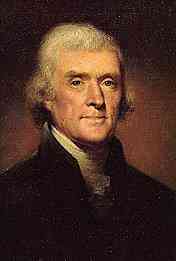
Elizabeth "Betty" Hemings was born around 1735, somewhere west of Monticello, Albemarle County, Virginia, now USA. She was an American slave owned by Thomas Jefferson (see pic), said to have been the concubine of Jefferson's father-in-law John Wayles, from whom Jefferson inherited her and her family. Over 75 of her children, grandchildren and great-grandchildren were enslaved at Jefferson's estate in Monticello.
According to the oral history of her descendants, Betty was the daughter of a slave-ship captain named Hemings and a woman born in Africa. Her place of birth is uncertain, but by the 1740s she was the property of Frances Eppes IV, of the Bermuda Hundred plantation, whose daughter Martha Eppes was to become John Wayles first wife.
Betty's grandson, Madison Hemings, related the story that Betty was already the property of "John Wales" at her birth, and her father Captain Hemings attempted to purchase her from Wayles, but Wayles refused because he was curious about how a mulatto child would develop. Captain Hemings then plotted to kidnap his daughter, which Wayles got word of, and took measures against. This account appears to contradict the documentary evidence pertaining to Betty's birth and early life, though it is possible that Wayles could have sold Betty to Frances Eppes, and later regained ownership of her via the dowry of Eppes's daughter, or that Madison's chronology is incorrect and the incident, if it occurred, happened later.
After the marriage of John Wayles and Martha Eppes 1746, Elizabeth became the property of Wayles, and was moved to one of his plantations, where she became a household servant. In the 1750s she gave birth to the first four of her 12 children, whose paternity is unknown.
John Wayles had three wives, all of whom pre-deceased him. In 1761, after the death of his third wife, Wayles took Betty Hemings as his concubine. According to her descendants, she had six children with Wayles including Sally Hemings (thought to have had a child with Jefferson). Wayles died 1773, and all 11 members of the Hemings family became the property of Thomas Jefferson.
Jefferson gave the Hemingses privileged positions as artisans and household servants. No member of the Hemings family ever worked the field. While resident at Monticello, Betty gave birth to another son, John, whose father was an Irish workman.
Betty had her own home at Monticello, where she spent roughly the last decade of her life, 1795-1807. Hemings sold cabbages, strawberries and chickens to Jefferson while she lived there. Her former cabin is now an archaeological site.

Relationship with John Wayles
Historians have tended to accept the account that Betty Hemings and John Wayles had children together, although, as in the case of many relationships between slave-owners and slaves, documentary evidence is slight. Betty was mentioned in John Wayles will, which some take as an indication of a relationship. Some of Betty's children, according to contemporary accounts, were nearly white. Other support is found in gossip from the first decade of the 19th century, which manifested itself in a few private letters which eventually became public. The accounts of former slaves Isaac Jefferson and Madison Hemings are the most well-known sources for the relationship.

(From Wikipedia)

20080207

Blandford Church


Old Blandford Church
BUILT IN 1735
A Confederate Memorial Since 1901
PETERSBURG, VIRGINIA
Located in Blandford Cemetery
On US Routes 301 - 460

Hanover Courthouse


The small village of Hanover, Virginia, sits as the County Seat of growing Hanover County. Surrounded by centuries of history, this town of nearly 500 people along US Route 301 has lodged many famous dignitaries at an over two centuries old tavern and has been the birthplace of many notable names in American History. The historic courthouse that sits off of the main highway was built in 1735.

20070907

Winchester, VA


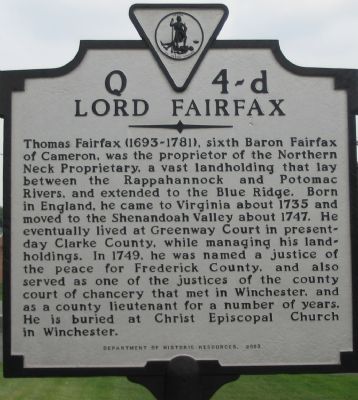
This marker is found in Winchester, Virginia, USA, and was erected in 2003. It refers to Lord Fairfax arriving in America 'about 1735'. For more see here.