This blog attempts to collate various materials in connection with the year 1735.
Showing posts with label art. Show all posts

20190715

Fashion by Carrington Bowels

Taste A-La-Mode as in the year 1735 being the contrast to the year 1745 is an etchig
that belongs to the British Musem from the late 1740s. It is by Carington Bowels (1724-1793)
20090311

Rokotov


Fyodor Stepanovich Rokotov (Fedor Rokotov) was born around 1735 (some say 1736) and died in 1809. He was a distinguished Russian painter, specialising in portraits.
Rokotov was born into a family of peasant serfs, belonging to theRepnions. Much in his biography is obscure. He studied art in St Petersburg and after buying back his freedom in the late 1750s became established as a fashionable painter.
In 1765, he was elected an Academician but did not work as a professor in the Academy long, because it interfered with his painting. He returned to Moscow 1765, where he lived for the rest of his life. He had many commissions there, becoming one of the best portrait painters of his time.
Among his best-known portraits are those of Alexandra Struyskaya (1772) (sometimes called the Russian Mona Lisa) and admittedly the most celebrated piece of the 18th-century Russian painting; of Countess Elisabeth Santi (1785) and Lady in a Pink Dress (1770s) - see pic.
Rokotov avoided painting formal portraits with lots of adornments and decorations. Instead he was one of the first Russian painters to advance the psychological portrait with attention to optical and atmospheric effects.
More here and here.

20081107

Boyne Obelisk


In 1735 (possibly 1736) a 130 feet obelisk was raised 3 miles west of Drogheda, marking the site of the 1690 Battle of Boyne. It is currently in a state of disrepair but some Orangemen are keen to put that right I understand. The painting is from 1757 and is by Thomas Mitchell (Who was born in 1735!).
The inscription read
'Sacred to the glorious memory of King William the Third, who, on the 1st of July, 1690, passed the river near this place to attack James the Second at the head of a Popish army, advantageously posted on the south side of it, and did, on that day, by a single battle, secure to us and to our posterity, our liberty, laws, and religion. In consequence of this action, James the Second left this kingdom and fled to France.'

20081003

Chardin 1735


Jean-Baptiste-Siméon Chardin (1699-1779) was an 18th-century French painter. He is considered a master of still life. His most famous work of 1735 is Lady taking tea. It was apparently painted in February 1735. His wife Marguerite Saintard died two months later. From the same time are The Young Sketcher, The School Mistress, The Embroiderer, The House of Cards, Rabbit with Copper Cauldron and Quince, Soap Bubbles and a portrait of Charles Godefroy (1706-1771). We have mentioned before his Boy with a top also of 1735.

20080201

St Benedict and a solar eclipse


Is this painting the earliest realistic depiction of a total eclipse of the Sun? Some historians believe so. The above painting was completed in 1735 by Cosmas Damian Asam, 1686-1739 (brother of Egid Quirin Asam), a famous early 18th Century painter and architect in Germany. The painting shows the solar corona and the diamond ring effect visible when sunlight flows only between mountains on the Moon. The person depicted viewing it all is St Benedict. Roberta J M Olson and Jay Pasachoff have hypothesised that Asam himself may have seen first hand one or all of the total solar eclipses of May 1706, 1724 and 1733. Asam's painting currently hangs in Weltenburg Abbey in Bavaria, Germany. It came to my attention as picture of the day on an astronomy site (see here). For more on Asam see here.

20080103

Canaletto 03


Giovanni Antonio Canal lived 1697-1768 in Venice. Other Canaletto works around 1735 include
Campo Santa Maria Formosa (in private hands)
Piazza San Marco, Vista hacia San Geminiano (Rome)
El puente Rialto desde el Sur (Rome)
Regata en el Gran Canal, después de (London) [See pic]

Also
Piazza San Marco: Vista sureste (Washington)
Entrada al Gran Canal: Desde el Oeste al Molo (Washington)
El Canal del Brenta en Padua (Washington)

Canaletto 02

Again around 1735, this is Feast of St Roch.

Canaletto


This Canaletto of the Grand Canal can be seen in Cologne and was painted c 1735

20071025

Utogawa Toyoharu


The Japanese artist Utogawa Toyoharu lived from 1735-1814. More info here.

20071005

Shark man

Sir Brook Watson, Bart (1735-1807) was a British merchant, soldier and one-time Lord Mayor of London. He was perhaps most famous for being the subject of Watson and the shark, a painting by John Singleton Copley which depicted the shark attack on Watson as a boy. As a result of the attack Watson lost his right leg below the knee. More here.

20070908

Ch'en Shu


This work entitled New Year's Day was produced in 1735 using ink and colours on paper. It is by Ch'en Shu (1660-1736) and is Qing Dynasty. Ch'en Shu was a native of Hsiu-shui in Chekiang Province, China. She was noted for her paintings of flowers, birds, insects and grasses and landscapes. Her brush was strong and vigorous and possessed the spirit of the antique. This scroll was painted when she was 75.

20070619

Maurice Quentin de la Tour


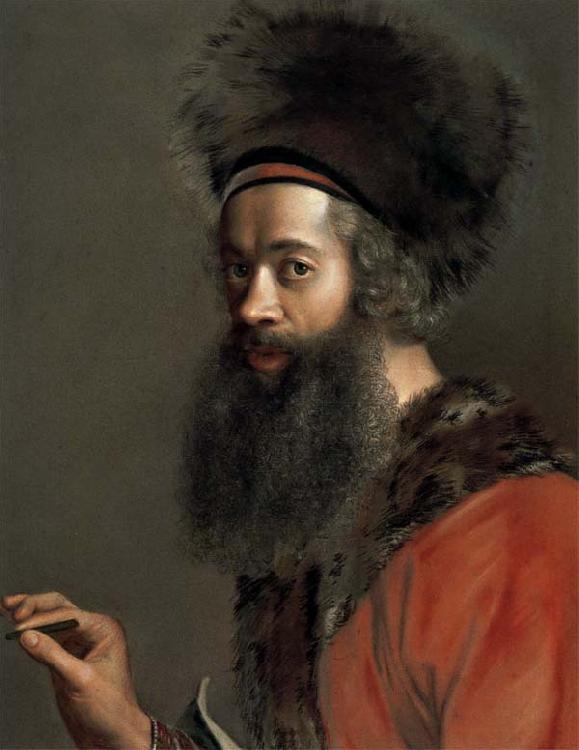
Self-portrait 1735 by Maurice Quentin de la Tour (1704-1788) in the Uffizi Collection

Michel Nicolas Bernard Lépicié


This painting is by the French painter, draftsman, and professor Michel Nicolas Bernard Lépicié who was born June 16, 1735. He died Sep 14, 1784.

20070608

Native American Chief

In 1735 Swedish artist Gustavus Hesselius completed this portrait of Minisink chief Tishcohan, who would later sign the Walking Purchase, for John Penn, the colonial's propriety and a grandson of William Penn. See here.

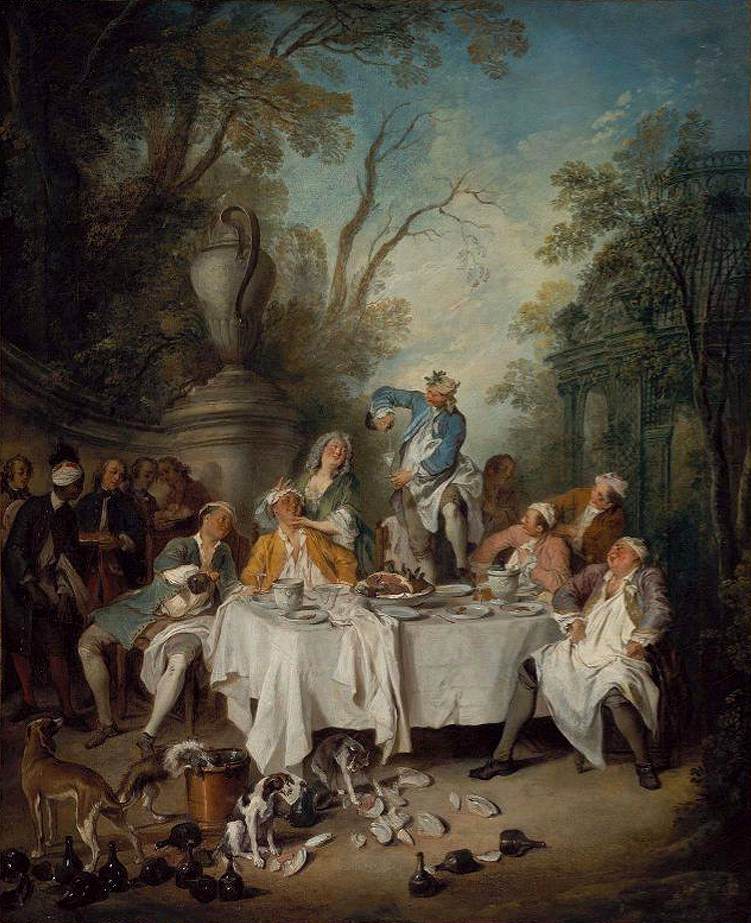
Lancret's Party

Lancret's Luncheon party or Pleasure party

Art

Painting
The Pleasure Party by Nicolas Lancret (1690-1743)
A Rake's Progress by William Hogarth (1697-1794) completed (he began his eight scenes in 1732)
Also his
The Good Samaritan?
The orgy
The Distressed Poet
Parliament passes a Copyright Act (Hogarth Act) to protect artists against pirating of their work in cheap copies. Hogarth had withheld his Rake's Progress pending enactment of the new legislation.
Boy with a Top by Jean-Baptiste Simeon Chardin (1699-1779)

The Soapmaker

The soapmaker by the German Martin Engelbrecht (1684-1756), c 1735. See here.

20070607

Native Americans


It would be another generation and a half before a second image of the Inoca would be created. In 1735 a French artist, Alexander de Batz (1685-1737), created this water colour. Caption "Indians of several Nations bound for New Orleans 1735." The seated female is labeled "Renard female Indian slave" (Mesquakie) and note the presence of the "Negro" (African) child (this is the earliest depiction of an African associated with the Pay du Illinois). The adult male to the right of the African child is labeled "Atakapas" (a native society from the Gulf Coast of Louisiana and Texas). All others in the image are "Illinois." The man standing to the left is labeled "Chief" while the crouching male is labeled "Dancer." (Peabody Museum, Harvard).