This blog attempts to collate various materials in connection with the year 1735.
Showing posts with label Wesleys. Show all posts

20080923

Wesley to his mother

To his Mother
OXON, January 13, 1735
DEAR MOTHER, -- Give my leave to say once more that our folks do, and will I supose to the end of the chapter, mistake the question.
Supposing him changed? Say they. Right: but that supposition has not proof yet – whether it may have: when it has, then we may come to our other point, whether all this be not providence, i.e. blessing. And whether we are empowered so to judge, condemn, and execute an imprudent Christian, as God forbid I should ever use a Turk or Deist.
I have had a great deal of a conversation lately on the subject of Christian liberty, and should be glad of your thoughts as to the several notions of it which good men entertain. I perceive different persons take it in at least six different senses: (1) For liberty from willful sin, in opposition to the bondage of natural corruption. (2) For liberty as to rites and points of discipline. So Mr. Whiston says, though the stations were constituted by the Apostles, yet the liberty of the Christian law dispenses with them on extraordinary occasions. [William Whiston (1667-1752) succeeded Newton as Lucasian Pro­fessor in 1703. The reference is to his book, The Primitive Eucharist Revived; or, an account of the doctrine and practice of the two first centuries. The ' stations' were the fasts: see letter of June 13, 1753, n.] (3) For liberty from denying ourselves in little things; for trifles, 'tis commonly thought, we may indulge in safety, because Christ hath made us free. This notion, I a little doubt, is not sound. (4) For liberty from fear, or a filial freedom in our intercourse with God. A Christian, says Dr. Knight, [James Knight, Vicar of St. Sepulchre's, London. See letter of May 8, 1739.] is free from fear on account of his past sins; for he believes in Christ, and hope frees him from fear of losing his present labor or of being a castaway hereafter. (5) Christian liberty is taken by some for a freedom from restraint as to sleep or food. So they would say, your drinking but one glass of wine, or my rising at a fixed hour, was contrary to Christian liberty. Lastly, it is taken for freedom from rules. If by this be meant making our rules yield to extraordinary occasions, well: if the having no prudential rules, this liberty is as yet too high for me; I cannot attain unto it.
We join in begging yours and my father's blessing, and wishing you an Happy Year. -- I am, dear mother,
Your dutiful and affectionate Son.
To Mrs. Wesley, At Epworth. To be left at the Post-house in Gainsborough. By London.
20071206

America

America 1735. The colony of Georgia prohibited importation of African slaves and rum. Settlement there spread to Augusta and John Wesley formed his first Methodist society. A French settlement appeared at Vincennes, Indiana near the Ohio River and St Genevieve on the Missouri River. In New England a Scarlet fever epidemic began. Botulism discovered in German sausages. England is distilling a gallon of gin for every man, woman and child in the nation.

20071105

Wesley's Journal 09


[Dec 1735]
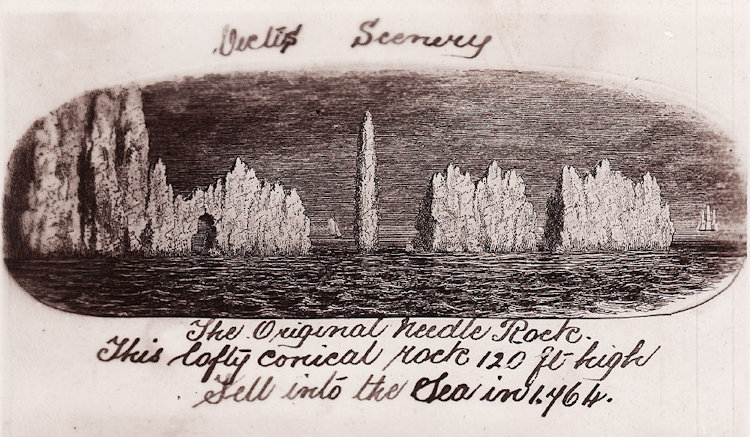
Wednesday 10, We sailed from Cowes, and in the afternoon past the Needles. Here the ragged rocks, with the waves dashing and foaming at the foot of them, and the white side of the island rising to such a height, perpendicular from the beach, gave a strong idea of Him that spanneth the heavens, and holdeth the waters in the hollow of his hand! Today I spoke closely on the head of religion, to one I had talked with once or twice before. Afterwards she said, with many tears, "My mother died when I was but ten years old. Some of her last words were, 'Child, fear God, and though you lose me you shall never want a friend.' I have now found a friend when I most wanted, and least expected one."

From this day to the 14th, being in the Bay of Biscay, the sea was very rough. Mr Delamotte and many others were more sick than ever: Mr Ingham a little; I not at all. But the 14th being a calm day, most of the sick were cured at once.

Thurs. 18, One who was big with child, in a high fever, and almost wasted away with a violent cough, desired to receive the Holy Communion before she died. At the hour of her receiving, she began to recover, and in a few days was entirely out of danger.

Sunday 21, We had fifteen communicants, which was our usual number on Sundays; on Christmas Day we had nineteen; but on New-year's-Day, fifteen only.

Wesley's Journal 08

Tuesday, Dec 2,
I had much satisfaction in conversing with one that was very ill and very serious. But in a few days she recovered from her sickness and from her seriousness together.
Sunday 7, Finding nature did not require so frequent supplies as we had been accustomed to, we agreed to leave off suppers; from doing which we have hitherto found no inconvenience ...

Wesley's Journal 07

[November 1735]
Thursday 20, We fell down into Yarmouth Roads ; but the next day were forced back to Cowes. During our stay here there were several storms; in one of which two ships in Yarmouth Roads were lost. The contrary winds gave my brother an opportunity of complying with the desire of the Minister of Cowes, and preaching there three or four times. The poor people flocked together in great numbers. We distributed a few little books among the more serious of them, which they received with all possible expressions of thankfulness.

Friday 21, One recovering from a dangerous illness, desired to be instructed in the nature of the Lord's supper. I thought it concerned her to be first instructed in the nature of Christianity; and accordingly fixt an hour a day to read with her in Mr. Law's Treatise on Christian Perfection.

Sunday 23, At night I was waked by the tossing of the ship and roaring of the wind, and plainly shewed, I was unfit, for I was unwilling to die.

20071008

Wesley's Journal 06

Friday 31 [October] We sailed out of the Downs. At eleven at night I was waked by a great noise. I soon found there was no danger; but the bare apprehension of it gave me a lively conviction what manner of men those ought to be who are every moment on the brink of eternity.
Saturday, Nov. 1, We came to St Helen's harbour, and the next day into Cowe's Road. The wind was fair, but we waited for the man of war which was to sail with us. This was a happy opportunity of instructing our fellow-travellers. May he whose seed we sow, give it the increase!
Sunday 16 [November], Thomas Hird, and Grace his wife, with their children, Mark, aged 21, and Phebe, about 17, late Quakers, were, at their often repeated desire, and after careful instruction, admitted to baptism.

20071005

Wesley's Journal 05


Friday 24 [October], Having a rolling sea, most of the passengers found the effects of it. Mr. Delamotte was exceeding sick for several days: Mr. Ingham for about half an hour. My brother's head ached much. Hitherto it has pleased God, the sea has not disordered me at all; nor have I been hindered one quarter of an hour from reading, writing, composing, or doing any business I could have done on shore. During our stay in the Downs, some or other of us went as often as we had opportunity on board the ship that sailed in company with us, where also many were glad to join in prayer and hearing the word.

20071001

Wesley's Journal 04

Tuesday 21 [October], We sailed from Gravesend. When we were past about half the Goodwin Sands, the wind suddenly failed. Had the calm continued till ebb, the ship had probably been lost; but the gale sprung up in an hour, and carried us into the Downs.
We now began to be a little regular. Our common way of living was this: From four in the morning till five, each of us used private prayer; from five to seven we read the Bible together, carefully comparing it (that we might not lean to our own understanding) with the writings of the earliest ages. At seven we breakfasted. At eight were the public prayers. From nine to twelve I usually learned German, and Mr. Delamotte, Greek. My brother [Charles. see pic] wrote sermons, and Mr. Ingham instructed the children. At twelve we met to give an account to one another what we had done since our last meeting, and what we designed to do before our next. About one we dined.
The time from dinner to four, we spent in reading to those whom each of us had taken in charge, or in speaking to them seriously, as need required, At four were the evening prayers; when either the second lesson was explained (as it always was in the morning) or the children were catechised and instructed before the congregation. From five to six we again used private prayer. From six to seven I read in our cabin to two or three of the passengers (of whom there were about eighty English on board) and each of my brethren to a few more in theirs. At seven I joined with the Germans in their public service; while Mr. Ingham was reading between the decks to as many as desired to hear. At eight we met again to exhort and instruct one another. Between nine and ten we went to bed, where neither the roaring of the sea, nor the motion of the ship, could take away the refreshing sleep which God gave us.

20070928

Wesley's Journal 03


Monday 20 [October], Believing the denying ourselves even in the smallest instances, might, by the blessing of God be helpful to us, we wholly left off the use of flesh and wine, and confined ourselves to vegetable food, chiefly rice and bisket. In the afternoon David Nitchman, bishop of the Moravians, and two others began to learn English. O may we be, not only of one tongue, but of one mind and of one heart!

Wesley's Journal 02

Friday 17 [October], I began to learn German, in order to converse with the Moravians, six and twenty of whom we had on board. On Sunday, the weather being fair and calm, we had the morning-service on quarter deck. I now first preached extempore, and then administered the Lord's Supper to six or seven communicants, A little flock. May God increase it !

20070628

Wesley's Journal 01

This is the opening entry in John Welsey's journal
Tuesday, October 14, 1735, Mr Benjamin Ingham, of Queen’s College, Oxford, Mr. Charles Delamotte, so of a merchant in London, who had offered himself some days before, my brother Charles Wesley, and myself, took boat for Gravesend, in order to embark for Georgia. Our end in leaving our native country was not to avoid want, (God having given us plenty of temporal blessings) nor to gain the dung or dross of riches or honour; but singly this, to save our souls; to live wholly to the glory of God. In the afternoon we found the Simmonds off Gravesend and immediately went on board. Wednesday and Thursday we spent with one or two of our friends, partly on board and partly on shore, in exhorting one another “to shake off every weight, and to run with patience the race set before us.”

20070608

The Wesleys, etc

The Renewed Moravian Church consecrates its first bishop in the person of David Nitschmann (1695-1772), restoring its own ministry separate from that of Nikolaus, graf von Zinzendorf. Zinzendorf sends missionaries to Britain's Georgia colony, where they will have little or no success.
John Wesley and his brother Charles lose their father (April 25) and embark in October for the Georgia colony with two other Methodists, a party of German Moravians sent by Zinzendorf and James E Oglethorpe (1696-1785), who had returned to England in 1734 and would not remain long at Savannah. The Simmonds encounters storms en route and John Wesley finds his fears greater than his faith. He later provoked criticism at Savannah but began the first Methodist society, and although his brother Charles soon returned to England, John remained for nearly two years.
Meanwhile in Swaffham, Norfolk, Robert Robinson (1735-1790), author of "Come Thou Fount of every blessing" and "Mighty God, while angels bless Thee", a Methodist and later Strict Baptist minister was born, on September 27.

20070607

Some deaths

Wikipedia again
Jan 12 - John Eccles, British composer (b 1668)
Jan 18 - Maria Clementina Sobieski, Polish princess (b 1702)
Feb 27 - John Arbuthnot, British physician and author (b 1667)
Apr 5 - William Derham, English minister and writer (b 1657)
Apr 25 - Samuel Wesley, Religious leader and poet, father of John and Charles (b 1662)
Jun 10 - Thomas Hearne, British antiquarian (b 1678)
Sep 27 - Peter Artedi, Swedish naturalist (drowned) (b 1705)
Oct 08 – Yongzheng, Emperor of China (b 1678)
Dec 14 - Thomas Tanner, English bishop and antiquarian (b 1674)

Intro

According to Wikipedia the year 1735 (MDCCXXXV) was a common year (ie one of 365 days)starting on a Saturday of the Gregorian Calendar.
The significant events of the year they list include
April 13 - Japan Emperor Sakuramachi accedes to throne
April 16 - London premiere of Alcina by G F Handel, his first Italian opera for the Royal opera House, Covent Garden
August 4 - New York, New York Weekly Journal writer John Peter Zenger acquitted of seditious libel against the royal governor, on the basis that what he published was true.
October - China, Qianlong Emperor succeeds Yongzheng and begins 60 year reign of Qing dynasty
Poland, War of Polish Succession concludes a preliminary peace (ratified 1738)
Of more interest to me is that this was the year of the conversion of George Whitefield and Hywel Harris and probably Daniel Rowland and that John Wesley began his famous journal (he and Charles were probably converted in 1738) and the Great Awakening was beginning in America.